Compost contains over 1 billion living organisms/cm3 and is sanitized by the work of nature, making it a valuable fertilizer that provides your plants with many defensive substances (e.g. penicillin) against diseases, fungal infestation and pests. The SUPERCOMP provides the ideal living conditions (complete aeration, even in the inner core of the heap) for the compost organisms responsible for processing the organic waste to multiply and quickly produce nutrient-rich quality compost.
Spread fresh compost in the garden under shrubs, trees, on the lawn, lightly hook it into the vegetable garden.
The compost removed from the storage chamber can be stored outside without affecting the soil and air until it is used in the garden. As well as having a fertilizing effect and repelling pests, compost also acts as a water reservoir and soil conditioner.
This is made possible by the vertical aeration in the SUPERCOMP the air-loving ("aerobic") compost organisms that are responsible for the composting process.
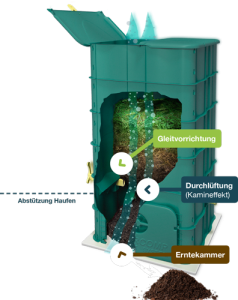
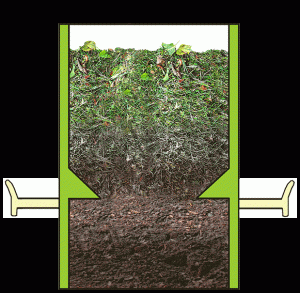
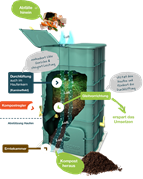
With its sliding and supporting device, the inner core of the heap is SUPERCOMP The inner core of the pile is also completely aerated from bottom to top (chimney effect), as the pile no longer rests on the ground with its full weight. This results in vertical aeration of the entire pile cross-section (chimney effect), eliminating unpleasant odors for you and your neighbors, no more annoying moving!
Conventional composters without a device are often poorly ventilated inside the core of the heap. In conventional composters without a device, the heap is surrounded by the walls of the composter, is only ventilated at the sides and lies with its full weight on the ground. The heap becomes compacted and hardly lets any air through. The air-loving compost creatures "toil" under a considerable lack of air. The result is a slow composting process (up to 24 months), which is often accompanied by unpleasant odors due to rotting. This is why composting experts recommend turning the heap several times a year, including dismantling and reassembling the appliance.
The answer is: yes, it works. The compost heap no longer rests with its full weight on the ground, but is supported by a sliding and supporting device approx. 25 cm above the ground. This means that the heap is also ventilated vertically and completely from bottom to top in the inner core of the heap (chimney effect).
-
As the Joanneum Research Institute has established in extensive series of tests, the vertical aeration of a SUPERCOMP enablesthe composting of only pure grass cuttings without the addition and mixing of other materials. The same applies to the application with leaves.
Simple answer: No.
A SUPERCOMP creates a compost result free of odors and without the tedious work of turning with the help of its supporting device. If you want to achieve an even faster and more nutritious compost result, it is advisable to mix grass clippings with a high nitrogen content with carbonaceous waste. This also improves the quality of the finished compost.
Experienced garden owners know that freshly mown lawn piled on a compost heap - rots and smells very strong.
Why? Fresh grass and lawn cuttings are high in nitrogen. Lawn cuttings also have a dense and fine structure and are very moist. In a pile lying on the ground (without the SUPERCOMP-support device), the grass clippings heap becomes compacted and may lack air . These compacted areas are ideal breeding grounds for the development of rotting nests (the excess nitrogen further intensifies this) and the unpleasant odors that arise as a result.
Conventional composters (usually from the cheap segment) without special technology are nothing more than heaps of compost lying on the ground in a plastic cover, which often allows even less air into the heap than without the cover. With these composters, the grass cuttings should be layered with leaves and other waste according to the instructions. If you want to avoid unpleasant odors and expect a reasonably quick composting result, you should dismantle and move these composters regularly (a 14-day interval is recommended).
If you are considering purchasing a composter "just" for lawn composting, you should definitely purchase a composter with the appropriate technology.
Note: Investigations on composting plants with conventional windrow composting have shown that there is a renewed lack of air just 24 hours (!) after the turning process, as the material collapses again and compaction begins again.
Depending on the climate and location, it can be said that a SUPERCOMP 350 liter can process a green area of 300 - 500 m2 when filled regularly.
The SUPERCOMP was tested by the renowned institute of the Graz University of Technology, Joanneum Research (Austria), in the "grass clippings reactor garbage can" test arrangement and the following results were obtained: Based on a total throughput of 910 liters over a period of 12 weeks and a residual volume of 160 liters, this results in a reduction in volume of around 82 percent. The reduction in volume was not constant but peaked in the 6th to 8th week under the given test conditions. Over time, the average reduction in volume was around 35 percent/week. In relation to the compost weight, this resulted in a weight reduction of around 150 kg within 12 weeks of composting.
The composting of grass clippings in a SUPERCOMP of exclusively fresh grass clippings leads to plant-compatible composts after a composting period of 12 weeks, a reduction in volume of 80% and a reduction in organic components of 64%.
In comparison, conventional compost heaps rot for approx. 12-24 months with unpleasant side effects!
These temperatures (at least more than 50°) are required to kill pathogens and weed germs (hygienization). Due to the high heat development, the material heats up to SUPERCOMP up to 80° (depending on the quantity and type of filling material, with the addition of e.g. fresh grass cuttings, heating up to 80° takes place within a few days).
In winter, of course, these temperatures are not possible, and freezing of the heap is not a misfortune, but has been normal in nature for millions of years: everything comes back to life in spring. If you want to prevent freezing, you would probably have to pack the composter with insulation as thick as that used in house construction; 2 cm thick plastic or wooden walls are not nearly enough.
The compost organisms responsible for a rapid composting process only work at full strength if they are provided with
- ongoing fresh food (waste)
- and sufficient air
- in an absolutely quiet environment
be supplied.
Compost creatures need plenty of rest. The compost worms flee immediately when disturbed. In the SUPERCOMP nothing is moved, as the heap does not need to be moved . The compost regulators also no longer need to be moved after the first adjustment.
The continuous and complete aeration of a SUPERCOMP Thanks to its patented support system, the compost worms and all other compost organisms are also supplied with sufficient oxygen in the inner core of the pile, so that they can happily stay there and do their work. Compost worms avoid areas where there is a lack of air and do their work very slowly.
Conventional composters (usually from the cheap segment) without special technology are nothing more than heaps of compost lying on the ground in a plastic cover, which often allows even less air into the heap than without the cover. The heavy compost heap resting on the ground is additionally compacted by its own weight, so that there is insufficient aeration. You can find more information on the problems with conventional composting here.
A SUPERCOMP offers ideal living conditions for worm reproduction. The waste is decomposed at high speed.
A SUPERCOMP wooden composter is made of domestic pine thermowood in durability class 1-2 (tropical wood quality). Using a completely organic thermal process, the wood is heated in a controlled manner to extract the substances that wood-destroying microorganisms (fungi) can live on (where there is no food, there is no fungus).
The wood is protected on the inside with attached PP hollow-chamber multiwall sheets. Polypropylene is considered the most environmentally friendly plastic and is fully recyclable. The intelligent hollow chamber system saves valuable raw materials compared to solid plastic.
The positive properties of Thermowood:
- Increased durability (against fungal attack and weathering) - even inside the wood
- Reduced swelling and shrinkage
- Increased dimensional stability
- Reduction of internal stresses in the wood
- The wood's equilibrium moisture content is reduced, i.e. with the same ambient temperature.i.e. in the same ambient climate, the moisture content of Thermowood is up to 70% lower than that of untreated wood
- New color shades can be created, ranging from a warm brown tone to the black of smoked oak
- All color changes are consistent and homogeneous across the cross-section
- Better thermal insulation properties than untreated wood
The SUPERCOMP is made from food-safe recycled plastic (polypropylene) in a special process with the addition of lime to further strengthen it. Nevertheless, a certain elasticity is retained, which balances out the forces acting on it and counteracts the risk of the plastic cracking even better in extreme weather conditions (hard plastic cracks quickly in extreme heat). The side "uprights" are reinforced and continuous slats additionally brace the construction to ensure maximum stability. When the composter is filled, it stands SUPERCOMP rock-solid, so that even strong winds cannot harm it. Polypropylene is considered the most environmentally friendly plastic and is fully recyclable.
The base plate is made of weather-resistant polypropylene (1,500 g/m2) and is 8 mm thick.
The base plate protects your ground from contamination and makes it easier to remove the finished compost thanks to the smooth surface. If you place the composter on paved surfaces such as terraces or concrete, the base plate is definitely recommended. If the composter is placed in the garden, you can SUPERCOMP on bricks or do without a paved base. This is also not a problem. However, make sure that the composter is set up horizontally (level the area before installation).
Organic waste is a valuable raw material for producing your own fertilizer. Everyone knows the prices for compost soil in the garden centers. In addition, you help the public waste collection service to save considerable costs of up to EUR 200 per year/family home, as your organic waste no longer has to be collected. Ask your local authority or municipal administration whether you can cancel the collection of organic waste. In some cases, local authorities will reimburse the costs or give you a bonus. You also contribute to climate protection and the reduction of particulate matter, as you relieve the environment of truck transports. Overall, households, local authorities and the environment all benefit from home composting.
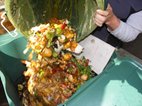
The pictures show an experimental setup at the Institute of Process Engineering at the Graz University of Technology. Lime, rock flour and sewage treatment plant substrate were added to the 300 liters of pure oranges in the sterile laboratory environment, and after 8 months the certainly difficult task of converting only oranges into compost was completed - see pictures 1-3.
In a series of tests at the Institute of Process Engineering at Graz University of Technology, only oranges were composted in a SUPERCOMP only oranges were composted. This test can be considered so difficult because oranges take much longer to decompose than other types of waste and, due to their high nitrogen content, must be mixed with other organic waste as much as possible in order to become compost at all. The purer the waste, the more difficult it is to compost. For example, attempts to compost surplus oranges in Sicily (Italy) using windrow composting were only successful when 2/3 of other biowaste was mixed in.
The pictures show the test setup at the Institute of Process Engineering at Graz University of Technology. Lime, rock flour and sewage treatment plant substrate were added to the 300 liters of pure oranges in the sterile laboratory environment. After 8 months, the certainly difficult task of converting only oranges into compost was completed.
As the SUPERCOMP is largely free of unpleasant odors, you won't have any problems with your neighbors. If odors do occur, then there is something wrong with the composting process that can be rectified quickly and easily. In this case, we can help you here.
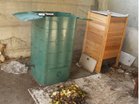
We show you a photo. This composter has been located in an inner-city courtyard (6 houses with approx. 130 residents) since 2008. A neighbor tried to have the composter banned by the authorities, but this was rejected by the authorities after on-site inspections due to a lack of evidence of odor nuisance. If you only want to compost your own waste and operate the composter yourself SUPERCOMP yourself, composting in residential areas with allotments is not a problem.

If an estate wishes to compost together, we recommend that a responsible person is appointed to carry out the following activities on a regular basis:
- Check for contamination of the waste
- Checking the moisture level and composting process
- Removal of finished compost
Experience has shown that composting in settlements with "anonymous" residents leads to problems, as many people unfortunately lack the necessary awareness for composting.
The Joanneum Research Institute of the Graz University of Technology (Austria) conducted empirical studies on the practical suitability and efficiency of the individual compost systems SUPERCOMP over 12 weeks and issued the following TESTAT:
TESTAT JOANNEUM RESEARCH, GRAZ - AUSTRIA
JOANNEUM RESEARCH conducted empirical studies over 12 weeks on the practical suitability and efficiency of the individual compost systems. SUPERCOMP were carried out.
The main innovative system components are sliding surfaces, which act as sliding wings to slow down the material flow in the downward movement and thus ensure a continuous composting process with optimized vertical aeration. The physical basis for this are different frictional forces between mature compost and immature rotting material, which leads to the formation of support lines for the stability of the rotting material and thus enables continuous process control. The selected surfaces and inclination angles of the sliding blades lead to the formation of support lines in the rotting material within the first 6 weeks.
Reactor garbage cans with different material compositions and a filling volume of 300 liters (wooden bins) and 350 liters (plastic bins) were investigated. The aim was to collect data on the nutrient balance, operational and functional stability, as well as the quality of the mature compost produced during practical operation. The feeding was carried out continuously a) with organic waste and b) with fresh grass clippings.
Reactor garbage can for grass clippings and reactor garbage can for organic waste
Based on a total throughput of 910 liters over a period of 12 weeks and a residual volume of 160 liters, this results in a reduction in volume of around 82 percent. The reduction in volume was not constant but peaked in the 6th to 8th week under the given test conditions. Over time, the average reduction in volume was around 35 percent/week. In relation to the compost weight, this resulted in a weight reduction of around 150 kg within 12 weeks of composting.
Summary
The composting of organic waste using SUPERCOMP with both test arrangements - from exclusively fresh grass clippings and the second test arrangement with organic waste from kitchen waste - leads to plant-compatible composts after a composting period of 12 weeks, a volume reduction of 80 % with a reduction in organic components of 64 %.
Note on our own behalf regarding lawn composting
The reduction in volume is even greater for loose grass clippings: in practice by 50% in the first week, as the material not only shrinks due to the composting process, but also packs together under its own weight after being placed in the composter.
Yes, we have many customers in densely populated areas who compost on their patio with the SUPERCOMP compost on their patio without any problems. If you want it to be completely clean, we recommend that you purchase a collection tray (DIY store), as some leachate may escape from time to time (only in extremely damp conditions). Simply place the composter in the tray. If it is filled with a lot of water, leave the tray out.
In any case, you should also order the base plate (only for plastic composters, this is included with wooden composters) and "inoculate" the base plate after installation. SUPERCOMP after installation.
- Compost worms work most effectively at a temperature of 15°-25° and ONLY with sufficient air supply (!). If it is too hot (as is the case with hot rotting, e.g. with fresh grass cuttings), the compost worms will retreat to cooler areas. After a few days of hot rotting, the helpers return and process the fresh material at lightning speed. The compost worms love freshly rotted organic material and remain invisible to humans from approx. SUPERCOMP invisible to humans from approx. 20 cm below the surface.
- They overwinter in cocoons, from which young worms hatch again in spring from 6°. If you also want to compost in winter in so-called "normal operation", we recommend a garage, a shed or a place close to the south wall of a house. However, winter operation outdoors is certainly restricted. Nevertheless, you can still put your waste in. In winter, there is usually less waste than in the warmer months.
- A compost heap must be aerated as well as possible. If this is not the case, the process comes to a standstill, takes much longer (up to 24 months) and can develop unpleasant odors due to rotting. The SUPERCOMP is ventilated completely vertically from bottom to top with the help of its sliding and supporting device (chimney effect).
- Compost heaps should not be moved, as the compost creatures (especially the compost worms) will immediately flee if disturbed and the composting process will have to be laboriously restarted. With a SUPERCOMP eliminates the otherwise necessary turning (= moving) and the composting process runs undisturbed.
- The environment for the living creatures should not be too damp or too dry. A composter protects the pile from sun and rain. In extreme weather conditions with constant heat or rain, you can quickly restore the ideal conditions yourself by adding "woody" materials(if there is too much moisture) or by "watering"(if it is dry). But don't worry: this happens extremely rarely. As long as you SUPERCOMP with fresh and moist materials, no problems are to be expected.
To summarize: A SUPERCOMP thermal composter with its patented sliding and supporting device provides the ideal living conditions for compost organisms (1 billion organisms per cm3). This allows them to do their work at turbo speed, multiply ideally and ensure a quick harvest of nutrient-rich quality compost.
In the conventional method, the composting process takes at least 12-24 months. This is where the thermocomposter acts like a turbo, because with a SUPERCOMP you can harvest your first raw compost after just 6-8 weeks.
Ventilation with sufficient oxygen - also in the inner pile core - is the decisive factor for optimum heat development.
With its patented sliding and supporting device, a SUPERCOMP is completely ventilated vertically from bottom to top (chimney effect). This is the only way to achieve these temperatures inside. This effect is due to the compost bacteria, which - provided they are supplied with sufficient air - generate heat. Depending on the filling material, a SUPERCOMP can heat up to 80° after just a few days if, for example, 200 liters or more of fresh grass cuttings are added.
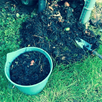
The composting process does not get off to a good start or the rotting process increasingly comes to a standstill if the compost is too dry. The compost organisms like it moist and composting is not possible without this. You can recognize compost that is too dry by a cracked, crumbly structure or if ants are spreading. The optimum condition of the compost resembles a squeezed out sponge. For this reason, avoid places that are in direct sunlight (plant a shrub in the area if you wish).
If the compost is too dry, simply "water" it and add a shovelful of stone meal. This also "oils" the sliding elements and increases the sliding speed. New waste such as fresh grass and moist kitchen waste will get the process going again. You can also take a little compost from the harvest chamber and add it, as this contains the microorganisms that are important for the composting process and gets it going again more quickly.
This is often correct. The reason for this is that conventional compost heaps are often created incorrectly and are not sufficiently turned and re-stacked on the farm. This tedious and "stinky" work is often omitted. Aeration is not or only insufficiently provided here, resulting in pockets of rot that spread an unpleasant odor. The composting process also comes to a standstill and takes considerably longer.
Foul odors due to lack of air
Many of our customers were also dissatisfied with their previous composters, where the same problems occurred. This is because - especially - cheap composters are usually just compost heaps "wrapped" in plastic without any technical inner workings. This also leads to a lack of air with the same problems. That's why manufacturers of these composters usually recommend turning them as you would a classic compost heap. To do this, you need to dismantle the composter, shovel the compost heap and re-layer it in the reassembled composter. You should do this regularly (at least every 14 days) to keep the composting process going.
Note: Studies on composting systems with conventional windrow composting have shown that there is a renewed lack of air just 24 hours after the turning process.
Foul odors passé
Ein SUPERCOMP eliminates these problems in the "no-turn" composter class. Thanks to the supporting device, the compost heap is fully aerated vertically even in the core (chimney effect) and no unpleasant odors are produced. The composting process is therefore extremely accelerated, allowing you to fill up to three times the amount of waste. There is no need for tedious turning as a base layer forms in the area of the device, which keeps the heap loose so that you can easily remove your finished compost from the harvesting chamber. If the heap is too compacted - as with conventional composting - it is difficult to remove finished material from under a heap weighing up to 100 kg.
Yes, composting yourself is avoiding waste, not contributing to C02 production by transporting waste, not participating in the production of microplastics, saving organic waste fees and producing your own fertilizer.
Composting yourself is...
Avoid waste
Organic waste neither ends up in the residual waste nor does it have to be disposed of separately in the organic waste garbage can.
Protecting the environment
No contribution to CO2 production through organic waste collection and treatment at the plant.
No participation in the production of microplastics
The sticky contaminants in the organic waste garbage can (plastic, residual waste) can only be partially sorted out and can be found shredded in the organic waste garbage can compost.
Production of living fertilizer instead of biologically dead compost: Compost contains over 1 billion living organisms/cm3 and is sanitized by the work of nature, making it a valuable fertilizer that provides your plants with many defensive substances (e.g. penicillin) against diseases, fungal infestation and pests.
Save on organic waste fees
Deregister your organic waste garbage can with the municipality and save on your annual organic waste fees. A few municipalities do not grant a fee discount.
The SUPERCOMP provides the ideal living conditions (complete aeration, even in the inner core of the heap) for the compost organisms responsible for processing the organic waste to multiply and quickly produce nutrient-rich quality compost.
Compost contains over 1 billion living organisms/cm3 and is sanitized by the work of nature, making it a valuable fertilizer that provides your plants with many defensive substances (e.g. penicillin) against diseases, fungal infestation and pests. The SUPERCOMP provides the ideal living conditions (complete aeration, even in the inner core of the pile) for the compost organisms responsible for processing the organic waste to multiply and quickly produce nutrient-rich quality compost.
In the SUPERCOMP you will never see these helpers because you do not have to move the heap. Only if, for example, you put a bucket of compost in your SUPERCOMP you will briefly see the valuable little animals, which will quickly hide away shy of the light and from then on work invisibly but hopefully not unappreciated in your service!
You can also use a SUPERCOMP Of course, you can also "only" compost kitchen waste. However, these have a high nitrogen content, which should be balanced out with carbon - i.e. "woody" materials such as tree, shrub and hedge cuttings, leaves, bark, straw, hay, wood shavings, sawdust, napkins or small bags.
The valuable compost worms in particular love added paper waste. 1 kg of compost worms cost more than the best meat from your butcher and produce expensive worm humus.
According to waste statistics, a maximum of 600 liters of kitchen waste is produced per family per year. SUPERCOMP processes more than 3 times this amount per year. Enough capacity for garden waste too!
When purchasing a composter, you should consider the performance (similar to a car, for example). This determines whether I can manage with one composter or whether I might need a second or third.
As waste is reduced by approx. SUPERCOMP is reduced by approx. 80% within 6 weeks, up to 3 times as much waste can be processed as with conventional composters, where the compost heap rests on the ground with its full weight. Of course, this also increases the purchase costs and the associated work.
Saving in the wrong place often leads to frustration, as we learn from emails from new customers who are finally looking for a composter that "really" works.
Compost is not only the best additive for all soils, but also the cheapest, as it is made from kitchen and garden waste.
The average allotment garden of up to 500 m2 harvests around 0.5 m3 of compost per year. In a home garden, the quantity is greater at 1 m3 if hedge cuttings and kitchen waste are included. 1,000 kilograms of compost (about 600 liters) is equivalent to 60 tubs. In comparison, 1 bag of organic sowing soil (15 kg bag) costs from around EUR 6.30 in the garden center (source: guide price from international garden center chain). The savings from home production can amount to several EUR 100 per year.
Home composting is therefore worthwhile and the purchase of a composter pays for itself very quickly.
Depending on the type of waste: The finer and softer they are in texture, the faster they become compost. Bone waste or thick branches take longer, but can also be composted. You can take out the first raw compost after just 6-8 weeks. Over time, the compost will become finer and finer.
Basically, the fertilizer is removed as required - or when it is full. SUPERCOMP is full - is removed. If you do not need the compost immediately, you can store it in the garden without any problems. Only due to the complete aeration of the SUPERCOMP This is also possible in the heap core.
Fresh compost in 2-3 months
Suitable for fertilizing lawns, soil surfaces and roots.
Fresh compost in 5 - 6 months
can be used in the garden or vegetable garden immediately before sowing/transplanting.
Mature compost in 10 - 12 months
can be brought into direct contact with seeds and roots.

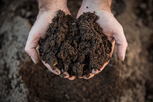
No. In a SUPERCOMP a separate ecosystem (biocenosis) with numerous compost creatures that are responsible for the composting process forms within a short time after commissioning. To get the biocenosis going even faster, you can "inoculate" the compost with compost worms. SUPERCOMPwithcompost worms.
To maintain the optimum balance, you should check the moisture level inside from time to time. The optimum condition of the compost resembles a squeezed sponge. You can recognize compost that is too dry by a cracked, crumbly structure or if ants are spreading. In this case, "water" with a little water and add a shovelful of rock flour.
However, if the compost is too wet, aeration and therefore the composting process will be disrupted. Then add "woody" materials such as straw, dry grass, bark mulch, paper napkins, paper bags and rotten leaves. You can also add 2-3 shovels of fresh raw compost from the harvest chamber, as this contains the microorganisms that are important for the composting process and gets the process going again more quickly.
Composting with SUPERCOMP has become as easy as possible if you pay attention to at least 3 points:
Always add woody items to the kitchen waste, e.g. leaves, branches (shredded) from the garden, sawdust. Do not put napkins in the waste paper, but compost them together with the food waste. Cover meat waste from flies, sometimes add a little lime or soil.
Pour in water if it has been dry for a long time. You can also "oil" the sliding elements with water to increase the sliding speed. Clean out the storage chamber regularly, leave compost residues to support the pile (if you want to compost more slowly) and also to absorb the valuable leachate that is released during the composting process. However, if the compost is too wet, add "woody" materials such as straw, dry grass, bark mulch, paper napkins, paper bags and rotten leaves.
The same applies here: The better the carbon - nitrogen ratio and the more diverse the waste, the better and faster the composting process.
Simple answer:
One SUPERCOMP fulfills several conditions at the same time, which together lead to a fast, odourless and also in the composting of pure materials to an optimal compost result.
As the Joanneum Research Institute has established in extensive series of tests, the vertical aeration of a SUPERCOMP enables the composting of only pure grass cuttings without the addition and mixing of other materials. The same applies to the application with leaves.
Apart from small residual amounts of branches and bones, no plant parts are recognizable. It consists of fine crumbs (pellets) and most of the compost worms have left the heap. Only the stem and individual leaf veins are still visible.
The base plate protects your ground from contamination and makes it easier to remove the finished compost thanks to its smooth surface.
If you place the composter on paved surfaces such as terraces or concrete, the base plate is certainly recommended. If the composter is placed in the garden, you can SUPERCOMP on bricks or do without a paved base. This is also not a problem. However, make sure that the composter is set up horizontally (level the area before installation).
It is often claimed that the compost heap needs an open connection to the ground so that living organisms can reach the inside of the heap.
From a technical point of view, it can be said that this is not true. The composting process also works purely bacterially, for example in large composting facilities where the windrows are piled up on paved ground. Our laboratory tests - including the composting of "only" oranges - with the Joanneum Research Institute of Graz University of Technology were also carried out in a hall on a concrete floor.
Composting with the SUPERCOMP is also possible on closed ground, terraces, etc. The base plate is impermeable to water and thus protects the subsoil. The smooth surface of the plate makes it easier to remove compost from the harvest chamber.
From an overall ecological point of view:
A connection to the soil is beneficial, but can also be replaced by the introduction of "compost life", for example by the user adding 2-3 tubs of raw compost or rotted leaves with compost worms. The ecosystem also grows in this way and living creatures migrate down through the small gaps in the removal flap at night.
Here you will find the assembly and installation instructions for your SUPERCOMP:
Assembly instructions SUP26001 (4-corner wooden composter)
Assembly instructions SUP26003 PP composter
Here you will find the assembly and installation instructions for your SUPERCOMP:
Assembly instructions SUP26001 (4-corner wooden composter)
Assembly instructions SUP26003 PP composter
The right ratio between carbon and nitrogen is important for ideal and rapid decomposition. Kitchen waste and grass cuttings contain a lot of nitrogen, so you should always add "woody" materials such as leaves, shredded branches, sawdust, napkins or small bags. Conversely, it is advisable to add nitrogen-rich materials to waste that contains too much carbon.
Nitrogen-rich waste includes fruit and vegetable waste, coffee and tea brew, potato haulm, grass and lawn cuttings, bouquets and potted plants, banana and tropical fruit peelings, weeds (without seeds, otherwise dried), herbs, wool, hair and manure.
High-carbon waste includes tree, shrub and hedge cuttings, leaves, bark, straw, hay, wood shavings, sawdust, napkins, small bags
The more colorful the mixture of waste, the better the quality of the end product. Add a scoop of rock flour, lime and soil from time to time. "Water" if the compost is dry, add "woody" material if it is too moist.
It is often claimed that the compost heap needs an open connection to the ground so that living organisms can reach the inside of the heap.
From a technical point of view, it can be said that this is not true. The composting process also works purely bacterially, for example in large composting facilities where the windrows are piled up on paved ground. Our laboratory tests - including the composting of "only" oranges - with the Joanneum Research Institute of Graz University of Technology were also carried out in a hall on a concrete floor.
Composting with the SUPERCOMP is also possible on closed ground, terraces, etc. The base plate is impermeable to water and thus protects the subsoil. The smooth surface of the plate makes it easier to remove compost from the harvest chamber.
From an overall ecological point of view:
A connection to the soil is beneficial, but can also be replaced by the introduction of "compost life", for example by the user adding 2-3 tubs of raw compost or rotted leaves with compost worms. The ecosystem also grows in this way and living creatures migrate down through the small gaps in the removal flap at night.
When the SUPERCOMP becomes full and you can no longer fill it with new waste, you should remove the finished compost from the storage chamber. If you do not need the compost straight away, you can easily store it in the garden. The compost will not lose any nutrients.
You do not need to shred kitchen waste and normal garden waste in advance. "Strong" material such as branches, roots or oversized shrub waste should be shredded so that this waste also composts more quickly.
Protection & best appearance for many years: Order JOTUN UV WOOD PROTECTION at the same time.
Your composter is a beautiful piece of garden furniture that is often exposed to all kinds of weather and sunlight. We therefore recommend treating your composter - at least the lid - with a UV wood protection varnish.
Many of our customers ask us which product they should use. Based on our experience to date, we can recommend JOTUN Demidekk Terrasslasyr in 4 selected colors (premium quality product).
JOTUN oils are mainly used in shipbuilding due to extreme weather conditions.
Of course, it is up to you to decide whether you want this protection.
You can also use a cheaper product (oil-based) from the DIY store.
Durability
Protection against UV fungi / UV radiation for at least 2 years (up to 4 years depending on weather conditions) - then repeat the process
Apply
with a brush once, then leave to dry for 1 hour and leave in again
(1 liter is sufficient per composter)
Note on the color shades
The "Natural" shade (Siberian larch) is closest to the images on our website.
Website Look Natural fiber 100% visible
Antique Look Walnut fiber 25% visible
Classic Look Chestnut fiber 50% visible
Modern Look Stone Grey fiber 5% visible
A certain amount of moisture is required for composting - the optimum condition of the compost is similar to a squeezed sponge. However, if the compost is too wet, aeration and therefore the composting process will be disrupted. Then add "woody" materials such as straw, dry grass, bark mulch, paper napkins, paper bags and rotten leaves. You can also add 2-3 shovels of fresh raw compost from the harvest chamber, as this contains the microorganisms that are important for the composting process and gets the process going again more quickly.
The composting process does not get off to a good start or the rotting process increasingly comes to a standstill if the compost is too dry. The compost organisms like it moist and composting is not possible without this. You can recognize compost that is too dry by a cracked, crumbly structure or if ants are spreading. The optimum condition of the compost resembles a squeezed out sponge. For this reason, avoid places that are in direct sunlight (plant a shrub in the area if you wish).
If the compost is too dry, simply "water" it and add a shovelful of stone meal. This also "oils" the sliding elements and increases the sliding speed. New waste such as fresh grass and moist kitchen waste will get the process going again. You can also take a little compost from the harvest chamber and add it, as this contains the microorganisms that are important for the composting process and gets it going again more quickly.
(Source: biorama.eu)
1. MATERIALS
Glass, metal and plastics clearly do not belong in the compost heap - there is no need for an explanation.
2. ash
Coal ash is only suitable for compost to a limited extent. The ash contains heavy metals in concentrated form and the large quantities of potash increase the salt content of the compost and lead to an oversupply of the soil over the years.
3. pesticide-laden substances
Although most pesticides are broken down in the composting process, these starting products can hardly be recommended. There is too little knowledge about the combination of active substances and the dangers of the degradation products. For example, chlopyralid (this active ingredient is approved as a weedkiller in agriculture, tree nurseries and home gardens) is not broken down either in the digestive system of a cow or in the subsequent composting of cow dung and is even harmful to plants in compost.
4. VACUUM CLEANER BAGS, STREET DIRT
The contents of vacuum cleaner bags and dirt from the street or parking lot contain tire abrasion, pollutants from the air, etc. Even with these materials, you don't know what you are introducing into the compost heap ecosystem.
5. LEATHER AND TREATED WOOD
Leather and wood are often impregnated with chemicals to preserve the leather or protect the wood. These also kill the soil life in the compost and are very difficult to break down as they are designed to resist the forces of nature.
6. DOG, CAT AND BIRD droppings
The droppings of these omnivores are usually contaminated with germs and parasites, which then become a problem if there is insufficient sanitization in the compost.
7. root weeds
Field thistle, couch grass or field bindweed are very tough and often a two to three centimeter long piece of root is enough to multiply magnificently in the compost heap. Roots that have been laboriously removed from the beds should therefore be left to dry in the sun for around ten days, cut again to test whether the roots are still alive, and only then put into the composter!
8. WEED SEEDS
Weed seeds can only be destroyed in the composting process by the high temperatures of the hot rotting process. However, if the weeds are weeded before they flower, there are certainly no seeds and the young plants are much easier to remove from the bed.
9. MEAT, Sausage, BONE
may only be composted if hot rotting takes place by adding fresh waste. Never compost large pieces or whole animals! Avoid in areas where there are problems with rodents. Meat scraps should be covered to protect them from flies.
Place your SUPERCOMP in a place where it is largely protected from bad weather conditions (places with a lot of wind and in the blazing sun). As the SUPERCOMP is largely free of unpleasant odors, it can also be installed on the neighbor's border or near your kitchen.
Apart from small residual amounts of branches and bones, no plant parts are recognizable. It consists of fine crumbs (pellets) and most of the compost worms have left the heap. Only the stem and individual leaf veins are still visible.
The compost regulators are part of the device for supporting the heap, the heap no longer rests with its full weight on the ground and is therefore also fully aerated in the heap core. More information on the technology and function of the SUPERCOMP can be found here.
When installing, set the controls to the following position: (Fig.)
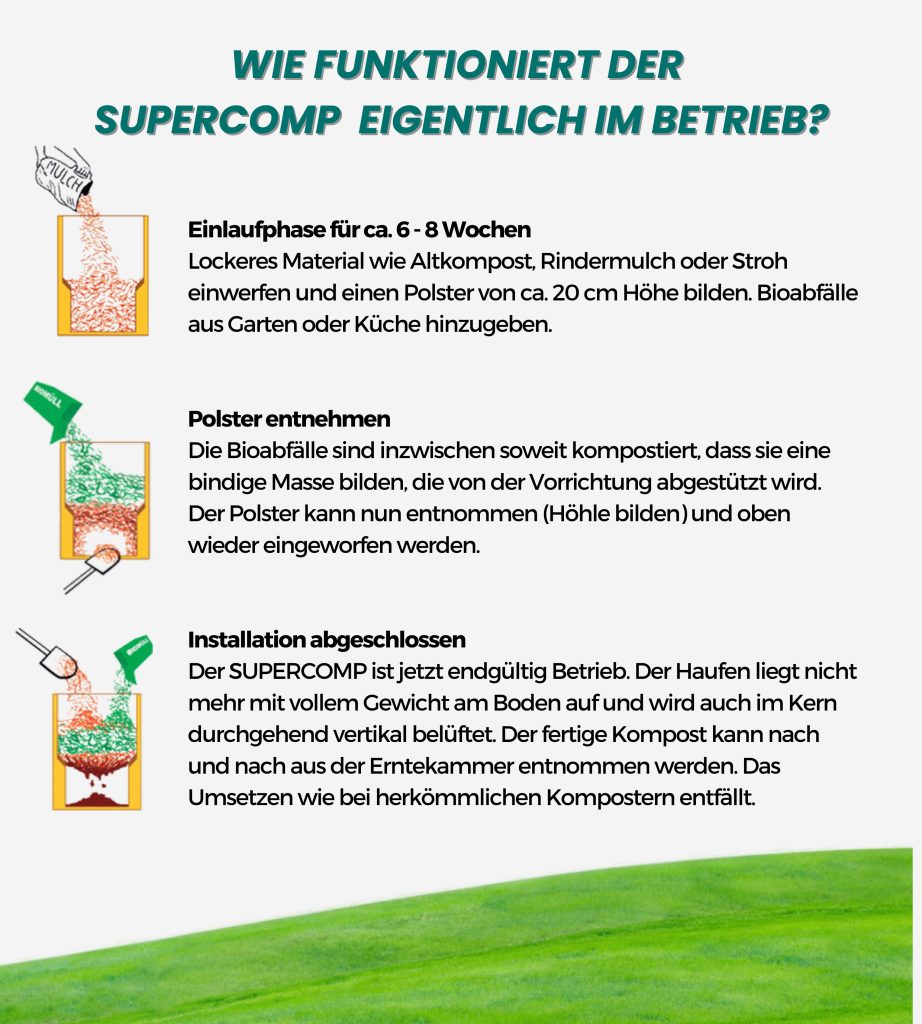
The material thrown in falls to the bottom first. After the run-in phase of approx. 6 weeks, the biowaste has composted to such an extent that it forms a cohesive mass that is supported by the device. The compost regulators are fixed after the running-in phase and cannot be pulled out by playing children, for example. You do not need to change the regulator position later. Further information on commissioning the SUPERCOMP can be found here.